


 English
 中文简体
中文简体 русский
 Español
Sep 14,2026
You are finalizing a 500ml cleaning solution bottle and the trigger feels loose in your hand. The spray pattern is uneven, the nozzle drips after two pulls, and the first few strokes produce nothing but air. These are the kinds of problems that turn a promising household product into a return. The root cause is often not the liquid formula but the trigger sprayer itself.
Selecting spray triggers for bottles is a decision that sits at the intersection of mechanical reliability, chemical compatibility, and user experience. For buyers responsible for packaging, the trigger is not just a plastic component; it is the primary interface between the user and the product. A trigger that fails communicates a poor product. A trigger that feels cheap communicates a cheap brand. So the selection process deserves the same scrutiny as the formulation that goes inside the bottle.
Content
- 1 Start with the Neck Finish: Not All Bottles Accept the Same Trigger
- 2 Material Selection Affects Chemical Resistance and Longevity
- 3 Nozzle Design Controls Spray Pattern and User Experience
- 4 Dosage and Output Consistency
- 5 Locking Mechanisms Prevent Leaks in Storage and Transport
- 6 Which Trigger Sprayer Specifications to Ask Your Supplier For
- 7 Evaluating Trigger Quality Before Placing a Large Order
- 8 When a Simple Trigger Is Enough and When It Is Not
- 9 Working with a Trigger Sprayer Manufacturer
- 10 Making the Final Selection
Start with the Neck Finish: Not All Bottles Accept the Same Trigger
Before comparing trigger styles, you need to confirm your bottle neck diameter and thread type. For most cleaning, garden, and personal care applications, the standard is a 28/410 neck finish. This means the neck measures 28mm across and the thread profile follows a 410 style. Some products use 24/410, especially in smaller bottles or disinfectant sprays. The difference between 28/410 and 24/410 is significant enough that the wrong trigger simply will not screw on properly.
Trigger sprayers for bottles are manufactured with a specific closure size. A trigger designed for a 28/410 bottle will not seat correctly on a 24/410 neck. Even if you force it, the internal gasket will not compress as designed, which leads to leakage around the cap. This is one of the most common assembly errors in packaging.
| Neck Finish | Typical Applications | Dosage Range |
|---|---|---|
| 24/410 | Fine mist disinfectants, travel-size cleaners, hand sanitizers | 0.2ml – 0.4ml per stroke |
| 28/410 | Household cleaning, garden sprayers, automotive chemicals | 0.8ml – 1.2ml per stroke |
| 33/415 | Heavy duty industrial degreasers, concentrated dilutables | 1.0ml – 1.5ml per stroke |
The practical implication is simple. You need to know the exact neck measurement of your bottle before scrolling through trigger options. If your supplier list includes a 28mm trigger with a ribbed skirt, it is intended for that standard. When you are sourcing from a factory, ask them for a sample that matches your exact bottle so you can verify thread engagement and gasket compression with your own hands.
Material Selection Affects Chemical Resistance and Longevity
Trigger sprayers are made primarily from polypropylene (PP) and polyethylene (PE). PP is the dominant material for trigger bodies because it holds dimensional stability well and can be molded with complex internal passageways. PE is often used for the dip tube and sometimes for the nozzle head. Both are typically paired with a stainless steel spring, which provides the return force for the piston mechanism.
The choice of material is not simply an aesthetic decision. If your product contains a solvent-based degreaser, an aromatic fragrance, or a high-percentage alcohol solution, you need to verify that the plastic and the elastomer seals can tolerate continuous exposure. Trigger sprayers for bottles used in industrial applications require stronger chemical resistance than those used for a simple glass cleaner. Some manufacturers offer PP triggers with different grades of rubber or polyethylene gaskets to handle more aggressive formulations.
For the tube, choose a length that reaches the bottom of your bottle. A 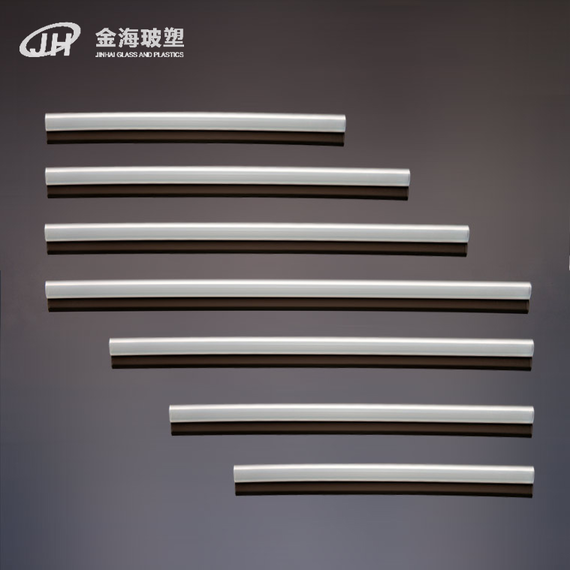 PE Plastic Tube with 3.7mm Diameter for Trigger SprayersThis polyethylene tube helps reach the bottom of bottles and prevents kinking, ensuring consistent flow. High transparency allows easy monitoring of liquid levels during suction or transfer.View Product → of the correct diameter and wall thickness can prevent kinking, which is a common cause of intermittent flow. If your bottle has a tall or irregular shape, a flexible PE tube at 3–7mm OD is usually suitable.
For the spring, 304 and 316 stainless steel are the standard choices. The spring determines the number of strokes the user can achieve before fatigue makes the trigger feel weak. A 304 stainless spring is adequate for most consumer products. A 316 grade is more appropriate for formulations that may cause chloride-related corrosion over time.
Nozzle Design Controls Spray Pattern and User Experience
The spray pattern is determined by the internal geometry of the nozzle and the swirl chamber. Some trigger sprayers produce a fine mist, while others generate a targeted stream. The most versatile trigger sprayers for bottles allow the user to adjust the nozzle from a fine mist to a narrow stream by rotating the nozzle head.
Consider an everyday scenario. A bathroom cleaner needs a wide mist to cover a surface, while a citrus degreaser benefits from a stream to direct liquid into a narrow gap. If you sell a single-purpose product, a fixed nozzle might suffice. If you sell a multi-surface cleaner, the adjustable version is the better investment because it costs only a little more and reduces the likelihood of consumer complaints.
The nozzle sprayer head also needs to resist clogging. In diluted chemical formulas, dried residue can block the fine mist orifice. A trigger with a simple open-and-close mechanism is harder to flush. A trigger with a twist-and-click design allows the user to rinse the nozzle under water without disassembling the entire head. This is a practical detail that buyers often notice after several weeks of use.
Dosage and Output Consistency
Trigger sprayers are rated for a specific volume of liquid dispensed per stroke. Common output values range from 0.8ml to 1.5ml. The dose matters because it affects how quickly the user empties the bottle and how many strokes are needed to cover a surface.
For a general purpose household cleaner, an output of 1.0ml to 1.2ml per stroke is a good balance. For a concentrated product that must be diluted, a lower output gives the user better control over dilution ratios. For a heavy-duty product, a higher output reduces the number of strokes needed to dispense the same volume.
Consistency is more important than absolute volume. A trigger that delivers 1.2ml on the first stroke and 0.9ml on the tenth indicates a weak spring or an internal air leak. Ask your supplier for a stroke output consistency test, or run an in-house test with a precision scale. Most factories will provide this data if you specify the test conditions.
Locking Mechanisms Prevent Leaks in Storage and Transport
Trigger sprayers often come with a locking mechanism that prevents accidental discharge. The most common types are a twist lock, a push-pull lock, and a trigger lock located under the trigger. The locking mechanism serves two purposes: it prevents leakage during shipping, and it prevents the user from spraying the product when the nozzle is left in the open position.
For household products, a simple twist-and-lock on the nozzle head is usually sufficient. For garden and industrial triggers, a trigger lock that secures the trigger in place when the bottle is not in use is preferable. Some triggers feature a ratchet closure that prevents the cap from vibrating loose during transport.
If you are shipping bottles filled with liquid, the trigger should also have a sealing gasket at the neck. The gasket is usually made of PE foam or a similar soft material. A 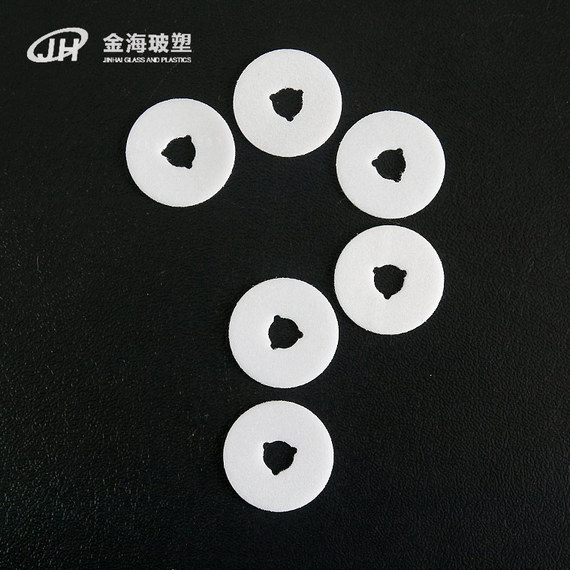 PE Foam Gasket for Trigger Sprayer Neck SealingThis PE foam gasket provides a tight compression fit at the bottle neck, reducing leakage risk. Its high tensile strength maintains sealing force over time, essential for long-term storage.View Product → is specifically designed to create a tighter compression fit for trigger applications. The thickness and density of this gasket directly affect the risk of leakage during transit.
If your product will be stored for several months before reaching retail, a foam gasket with good compression set resistance is essential. A gasket that compresses too quickly loses its sealing force over time. A PE foam gasket with high tensile strength will maintain its integrity longer.
Which Trigger Sprayer Specifications to Ask Your Supplier For
When you contact a spray trigger manufacturer, provide these details to get the most accurate quotation and sample:
- Your bottle neck size (e.g., 28/410, 24/410, 33/415)
- Target dosage per stroke in milliliters
- Spray pattern preference (fine mist, stream, adjustable)
- Main chemical components of your formula
- Color and surface finish requirements
- Estimated annual order quantity
- Storage temperature and shipping conditions
If your product contains aggressive solvents, ask the manufacturer to recommend a specific grade of PP or PE. Some factories stock 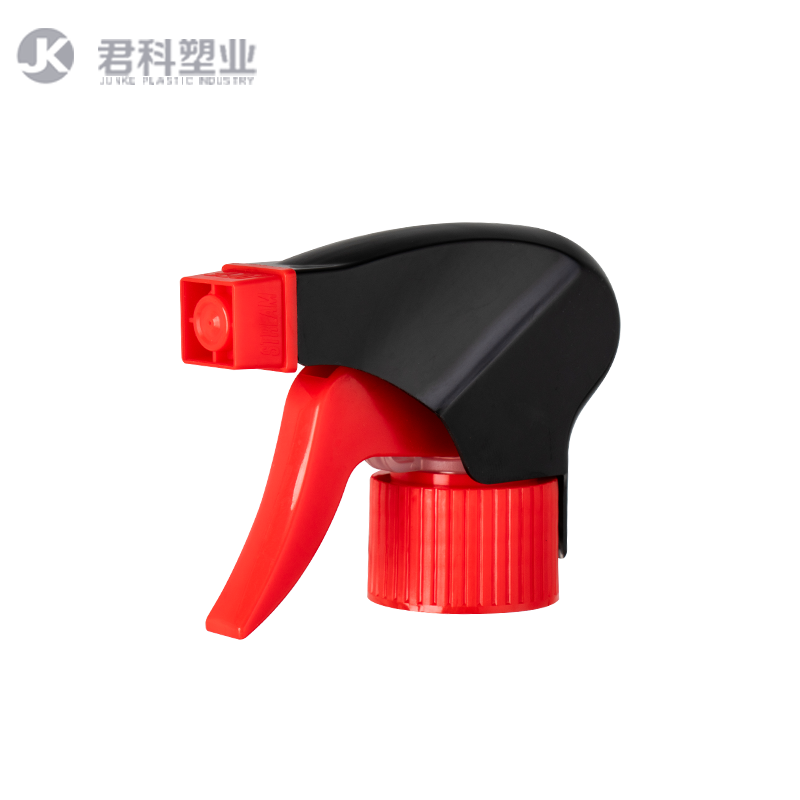 28mm Plastic Trigger Sprayer for Garden and CleaningThis red-and-black trigger sprayer suits garden and cleaning bottles. Its material can be customized for aggressive solvents, and the design offers reliable performance for industrial and outdoor use.View Product → formulations that have been tested with common industrial chemicals. A standard off-the-shelf trigger may not survive long-term contact with strong solvents, so an OEM/ODM trigger with custom material selection is safer for industrial and garden products.
Evaluating Trigger Quality Before Placing a Large Order
Sampling is the only reliable way to verify that a trigger sprayer performs as promised. Request at least 20 samples from two or three different suppliers. Test them with your actual bottle and formulation. Listen to the trigger mechanism. Look for any signs of fluid in the nozzle cavity. Measure the output over 10 consecutive strokes using a small graduated cylinder or a precision scale.
A production trigger that exhibits any of the following faults should be rejected:
- Inconsistent output across repeated strokes
- Dripping from the nozzle after release
- Air uptake that causes a sputtering stream
- Excessive force required to operate
- Difficulty rotating the nozzle head
- A cap that does not engage the bottle threads smoothly
Pay close attention to the fit between the trigger and the bottle neck. A loose cap that can be turned by hand with minimal resistance is a risk. A trigger that requires excessive torque to close is equally problematic, as it may crack the bottle neck during high-speed filling lines.
When a Simple Trigger Is Enough and When It Is Not
If your product is a mild surface cleaner sold in the mass retail channel, a basic PP trigger with a 28/410 closure, 1.0ml dose, and a twist-lock nozzle head is likely sufficient. This configuration is well proven, costs little, and minimizes inventory complexity.
If your product is a professional-grade degreaser or a concentrated product for commercial use, consider a heavier trigger with a larger output and a lockable trigger. These features reduce user fatigue and improve safety. For garden and automotive products, an adjustable nozzle is often the differentiator that customers mention in reviews. A trigger that can switch between a fine mist and a direct stream makes the product more useful in more situations without requiring multiple bottles.
For a trigger to feel reliable, the inner components also have to work in harmony. The dip tube is connected to the pump housing. The inside the pump chamber provides the return force. This spring is a small but critical element. A weakly tensioned spring will cause the trigger to feel mushy. A spring that is too strong will make the user tire faster. A good supplier can tune the spring to your target output, but they need to know the viscosity and temperature of your product.
Working with a Trigger Sprayer Manufacturer
For brands that need more than a stock component, custom trigger sprayers are available. OEM/ODM factories can produce triggers in your brand color, with custom engraved logos, and with specific dosages that match your product. They can also supply matching dip tubes and gaskets to ensure compatibility across the entire pump assembly.
When evaluating a Chinese factory for trigger sprayers, ask about their in-house testing procedures. A factory that measures output after 1,000 strokes will have a different quality level than one that only checks cosmetic appearance. Request the tolerance specifications for the trigger's stroke volume and the leak test criteria. If the supplier cannot provide output consistency data from a calibrated testing rig, ask for a sample batch and perform your own checks.
Also consider the full supply chain. If you need a sealed assembly with a PE gasket and a precise dip tube, a single supplier that produces both triggers and accessories can reduce coordination issues. Many packaging failures happen because the trigger, tube, and gasket come from different sources and do not align perfectly. Sourcing these components together from a factory that understands the complete pump mechanism is often the smoother path.
Making the Final Selection
Choosing the right spray triggers for bottles starts with knowing your bottle geometry and the chemical profile of your product. Then weigh the benefits of different nozzle designs, dosage outputs, and locking mechanisms. Consider user expectations in the target market. A garden sprayer user expects a higher output than a cosmetic toner user. An industrial degreaser user expects chemical resistance and durability. A home cleaning consumer expects a clean lock that prevents accidental discharge.
The cost of a trigger sprayer is a fraction of the cost of your finished product, but its performance has an outsized impact on brand perception. A well-chosen trigger that produces an even spray, seals reliably in transport, and operates smoothly from the first stroke to the last is worth a few extra cents. Testing with your exact product composition is the only way to know for certain. Choose a partner who can supply the trigger, the tube, and the gasket as a matched set, and you will avoid most of the packaging problems that cause complaints downstream.