


 English
 中文简体
 русский
 Español

Oct 26,2026
If you have a half-ounce bottle in one hand and a specification sheet in the other, you are in good company. We spend our working days around small bottles, pump heads, and dip tubes, so the question "0.5 oz in ml" comes up more often than you might expect.
The short answer is that 0.5 US fluid ounces equals 14.79 milliliters, or 14.7868 ml if you want every decimal. Read the same figure on a British or older imperial label, though, and 0.5 fluid ounces is 14.21 ml. And if that "oz" refers to weight rather than volume, 0.5 ounces is 14.17 grams. Which one you need depends entirely on what is being measured and where the label was printed.
Content
- 1 0.5 oz in ml: The Numbers Side by Side
- 2 Fluid Ounces and Weight Ounces Are Not the Same Thing
- 3 Conversions You Will Actually Use
- 4 What a Half-Ounce Bottle Looks Like on a Filling Line
- 5 Matching Pump Output to a 15 ml Bottle
- 6 Why Small Volumes Are Less Forgiving
- 7 How to Convert Ounces to Milliliters Yourself
- 8 A Few Notes From Our Own Workshop
0.5 oz in ml: The Numbers Side by Side
Ounces are not a single, tidy unit. Before you commit a number to a filling specification or a product label, it helps to know which ounce you are converting.
| Measurement basis | 0.5 oz converts to | Where you will see it |
|---|---|---|
| US fluid ounce (fl oz) | 14.79 ml | Cosmetic, personal care, and pharmacy labels in the United States |
| Imperial (UK) fluid ounce | 14.21 ml | Older UK and Commonwealth recipes and legacy labels |
| US nutrition labeling fl oz | 15 ml | Nutrition panels, where 1 fl oz is treated as 30 ml for simplicity |
| Ounce by weight (oz) | 14.17 g | Creams, powders, and anything sold by mass rather than volume |
For everyday packaging work, 14.79 ml is the number to keep. Most brands round it to 15 ml on the front of the bottle and hold the exact conversion for internal documents.
Fluid Ounces and Weight Ounces Are Not the Same Thing
This is the most common source of confusion, and it is worth thirty seconds of your time.
A fluid ounce measures volume — how much space a liquid takes up. A weight ounce measures mass — how heavy something is. They share a name, and for water they almost coincide, because 1 ml of water weighs roughly 1 gram. That is why a 0.5 fl oz (14.79 ml) bottle of water also weighs about 14.8 grams.
Step away from water and the two drift apart. A glycerin serum, a silicone primer, and an alcohol-based toner all have different densities, so 14.79 ml of each weighs a different number of grams. When a customer asks us to match a 0.5 oz fill, our first question is always the same: do you mean 14.79 ml of product, or 14.17 grams of it? The answer can change the bottle, the pump, and occasionally the whole filling line.
Conversions You Will Actually Use
Half-ounce questions rarely arrive alone. Here are the conversions that come up most often when people are sizing sample vials, travel bottles, and full retail packs.
- 5 ml = 0.17 fl oz — the classic sample vial and sachet fill
- 7.39 ml = 0.25 fl oz — quarter-ounce miniatures
- 14.79 ml = 0.5 fl oz — the number this article is about
- 15 ml ≈ 0.51 fl oz — the rounded figure most labels show
- 29.57 ml = 1 fl oz
- 50 ml ≈ 1.69 fl oz — usually printed as 1.7 oz
- 100 ml ≈ 3.38 fl oz — usually printed as 3.4 oz, and the familiar cabin-baggage limit
Notice how a half-ounce bottle sits comfortably inside the 100 ml travel limit, with room to spare. That is one reason the 15 ml size has stayed so popular for trial and travel sets.
What a Half-Ounce Bottle Looks Like on a Filling Line
In practice, a 0.5 oz cosmetic bottle is usually a 15 ml container: a slim PET or glass bottle, a small jar, or a soft tube. The tolerance for error is small. At 15 ml, a filling nozzle that is off by 0.5 ml is already more than 3 percent out, and an air bubble the size of a grain of rice can throw off a weight check.
That is why the accessories matter as much as the bottle. A mini set that travels needs a dip tube cut to the right length, so the pump keeps drawing product when the bottle is nearly empty, and a tube wall thick enough to survive being squeezed in a wash bag.
 Flexible PE Tubes for Travel-Size Cosmetic Mini SetsCustomizable PE tubes for mini sets, with soft, tear-resistant walls suited to travel packaging; transparent and fine-tipped options support small-format cosmetic applications.View Product →
We cut and form PE and PP tubes for exactly this kind of small-format work, including transparent tubes that let the consumer see how much is left and fine-tipped versions for controlled application.
Matching Pump Output to a 15 ml Bottle
Once you know the fill volume, the next question is how many doses the user gets. Pump output is expressed in cc, and 1 cc equals 1 ml, so the arithmetic is straightforward:
- A 4cc lotion pump delivers about 4 ml per full press — roughly 3.7 presses to empty a 15 ml bottle
- A 2cc screw pump delivers about 2 ml per press — closer to 7 or 8 presses
- A fine mist sprayer rated near 0.1 ml per activation gives the user well over a hundred sprays
None of these is automatically right. A shampoo sample in a 0.5 oz bottle feels generous with a 4cc pump and stingy with a 2cc one. A facial toner in the same bottle feels wasteful at 4cc. The dose, not the bottle, decides which pump head belongs on top.
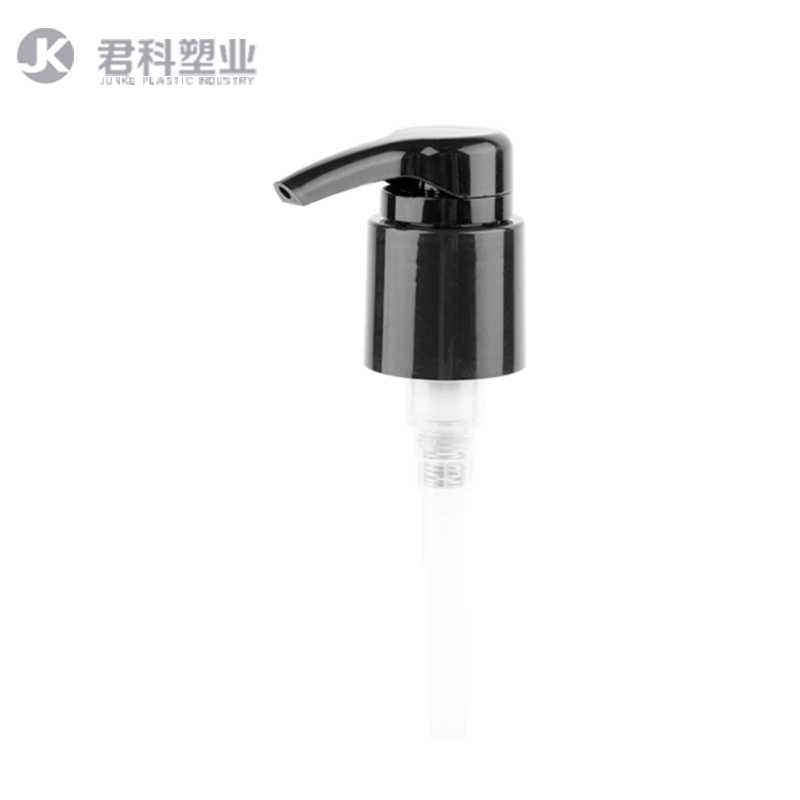 4.0CC Lotion Pump with 28/410 Neck for High-Viscosity LiquidsReplacement 4cc dispenser for high-viscosity cosmetics, available with 28/410 and 33/415 finishes; locking options help travel bottles avoid leaks.View Product →
Our 4cc pump range covers the common 28/410, 33/415, and 40/410 neck finishes, with up-down or left-right locking so a travel bottle does not leak inside a suitcase.
Why Small Volumes Are Less Forgiving
There is a quiet irony in small packaging: the smaller the fill, the more engineering it takes. A 15 ml bottle carries a proportionally larger cap, neck, and pump, which means more sealing surface per milliliter of product, more evaporation paths, and more places for a slow leak to start.
Three components do most of that work:
- Sealing gaskets, usually PE foam, that sit under the cap or pump collar and hold the closure airtight
- Small check balls — glass, POM, or PP — that control flow inside the pump body
- Compression springs, typically 304 or 316 stainless steel, that return the actuator to its resting position
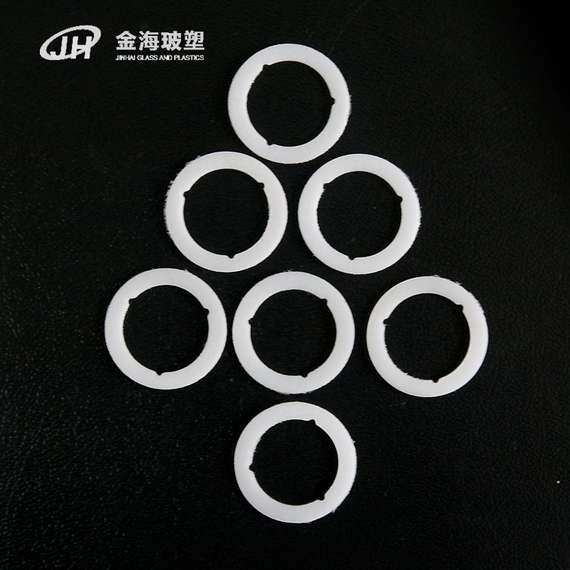 PE Foam Sealing Gasket for Cosmetic and Cleaning ContainersLightweight, soft PE foam gasket for air-tight cosmetic and cleaning spray bottles; customizable sealing helps prevent detergent leakage in storage.View Product →
Each one is a small part with a tight tolerance. When a customer reports that a 0.5 oz bottle lost weight over three months in storage, the answer is almost never the bottle itself — it is the seal, the ball seat, or the spring tension.
How to Convert Ounces to Milliliters Yourself
If you need a figure that is not on any chart, the calculation takes less than a minute.
- Decide whether the ounce in front of you is a fluid ounce or a weight ounce.
- Identify the system: US customary or imperial.
- For US fluid ounces, multiply by 29.5735. So 0.5 × 29.5735 = 14.7868 ml.
- For imperial fluid ounces, multiply by 28.4131. So 0.5 × 28.4131 = 14.21 ml.
- For weight ounces, multiply by 28.3495. So 0.5 × 28.3495 = 14.17 g.
- Round according to context — 15 ml for a label, 14.79 ml for a specification.
Going the other way, divide milliliters by 29.5735 to return to US fluid ounces. A 15 ml bottle, for example, is 0.507 fl oz.
A Few Notes From Our Own Workshop
Questions about half ounces usually come from people designing something small: a sample program, a hotel amenity, a travel kit, a perfume trial. Those projects live or die on details that are easy to overlook — a dip tube that is 2 mm too short, a gasket that is 0.2 mm too thin, a pump that doses more than the bottle can justify.
We are Yuyao Jinhai Glass and Plastic Manufacturing Plant, a component and pump manufacturer based in Yuyao, China. Our catalog runs from 1 mm plastic balls and 3 mm glass balls through complete 4cc lotion pumps, screw pumps, switch pumps, micro sprayers, and trigger sprayers, along with the PE gaskets, PE and PP tubes, springs, and rubber parts that hold them together. We work with OEM and ODM customers in cosmetics, personal care, household cleaning, and pharmaceuticals, and we export to markets including India and Russia.
If you are sizing a 0.5 oz pack, the useful starting point is not the conversion table but the dose. Work out how much product one press should deliver, then work backwards to the bottle volume, the pump output, and the dip tube length. Our notes on choosing the right dip tube size cover that last step in more detail.
And if you simply needed the number: 0.5 oz is 14.79 ml, or about 15 ml in everyday packaging language.